
LEOSA Gave You The Gun Back.
It Did Not Give Back The Uniform.
Congress settled whether you may carry. It said nothing at all about how the officers arriving are supposed to know which armed man in plain clothes you are.
Your Credential Is In Your Pocket.
The Problem Is On Your Chest.
Everything LEOSA gives you is a document you produce afterwards.
A photographic identification card from the agency you retired from. A certification that you qualified within the last twelve months. Both are real, both matter, and both live in a wallet.
Every one of those documents is proof for a conversation that happens later: with a prosecutor, with a court, with an officer who has already worked out that you are not the threat. None of it is proof for the three seconds that decide the encounter, because in those three seconds nobody is reading anything.
You spent twenty years being the person who arrives to a call like that. You already know exactly what the officer coming through the door is looking at, because it used to be your job to look. What he sees now is a man in a polo shirt with a gun.
The banner is the part of the credential he can read from across a room, from behind, before anyone has said a word.

What The Statute Actually Asks Of You
If you are carrying under LEOSA you already know this. It is here because the four things the law asks of you are the same four things we check before a banner ships.
Ten Years
An aggregate of ten years or more as a law enforcement officer, or separation because of a service-connected disability, after completing the probationary period.
Good Standing
Separated in good standing from service with a public agency as a law enforcement officer.
Photographic ID
Issued by the agency you retired from. Either it states that you qualified within the last year, or a separate certification from your state or a certified instructor does.
Annual Qualification
Within the last twelve months, at your own expense, to the firearms standard for active officers, set by your former agency, your state, or a certified instructor.
LEOSA does not override everything.
The statute is explicit that it leaves two things alone: state laws that let private property owners prohibit or restrict concealed firearms on their own property, and restrictions on carrying on state or local government property, installations, buildings, bases and parks.
Worth saying plainly on a page selling a banner: the banner changes none of that, and nothing here is legal advice. Your qualification and your identification are administered by your former agency and your state, not by us.
Requirements and limitations above are a summary of 18 U.S.C. § 926C. The section is short, and worth reading in full.
Two Words That Do Two Different Jobs
Which one you want depends on who you need to be legible to: the public in the room, or the officer clearing it.

Retired Police
Says what you were, in a word every civilian in the room understands instantly. RETIRED sits above POLICE, so it never claims current authority.
- Reads
- Front & Back
- States
- Former service
- Carry
- Belt pouch
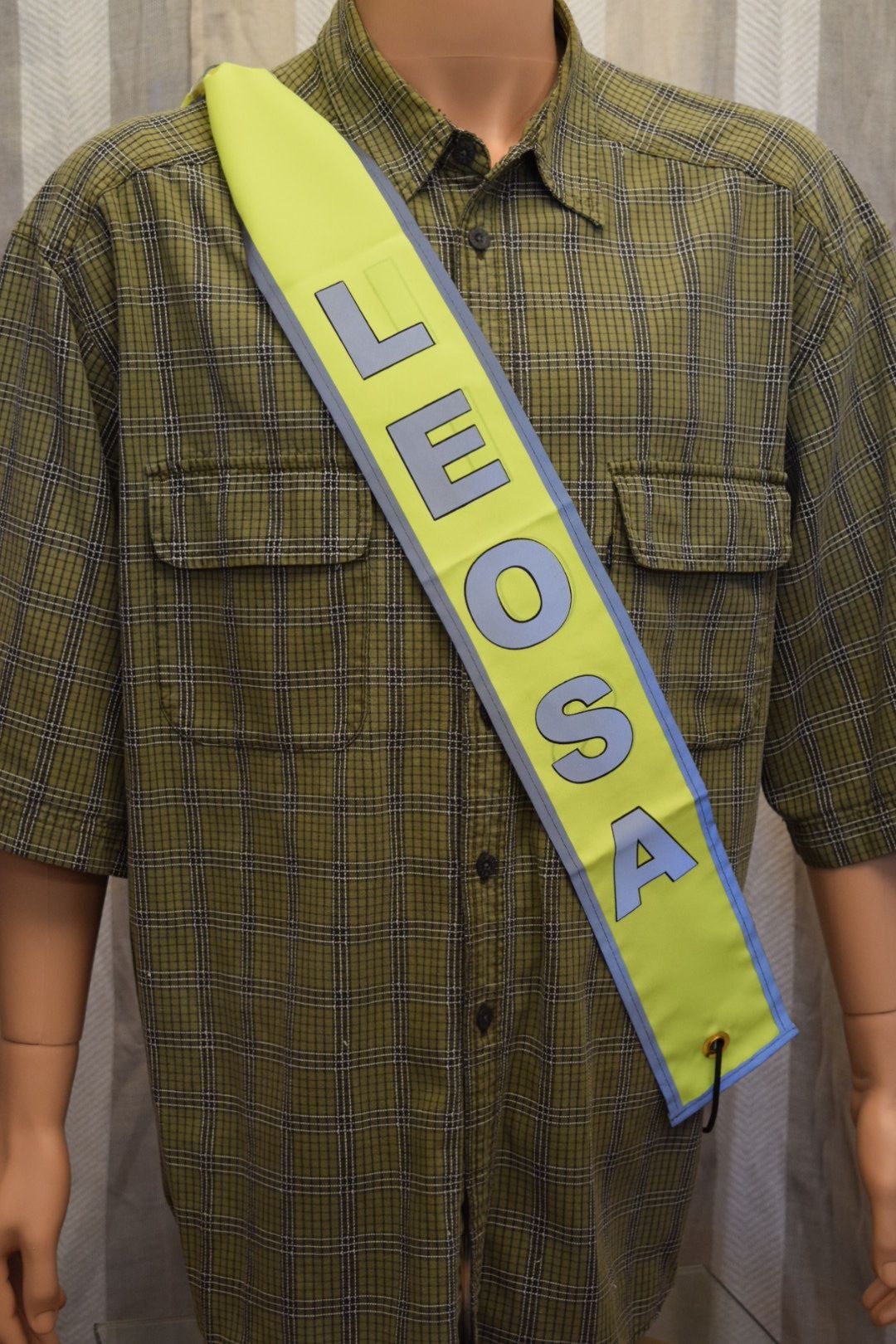
LEOSA
Says the specific thing a responding officer is trained to recognize. Five letters that answer why you are armed, without claiming to be on duty.
- Reads
- Front & Back
- States
- Carry status
- Carry
- Belt pouch
Nobody Buys One Of These Anonymously
A RETIRED POLICE banner in the wrong hands is worth less than nothing to the person wearing one legitimately. That is why the check exists, and why it applies to you as well.
Choose Your Designation
RETIRED POLICE or LEOSA, front and back, in the belt pouch. Ordered like anything else in the shop.
Upload Your Credentials
At checkout, not by email afterwards. Your retired identification, and your qualification if your card does not already carry it.
We Check Them
A person reads them. Nothing ships against an expired qualification or an identification we cannot reconcile, and you will be told why.
Then It Ships
From Sparks, Nevada. The delay is the point: it is what keeps the word on your chest worth something.
From The Law Enforcement Experts
DSM’s reference base today is law enforcement, so that is whose words are below. We are not going to put a quote in a paramedic’s mouth to fill a gap. If your service runs these and would say something on the record, we would like to hear from you.
I purchased them and have them in place with my lieutenants, detectives, school resource officer, myself and others ready for special events.Chief William L. HarveyEphrata Police Department
It's Life Insurance on your hip!Ken HackathornPolice / Military Tactics Instructor & Gunwriter
Not a single plain clothed officer was engaged whatsoever, even in a low light situation.CyrilLE Training · McKinney TX PD active shooter refresher
You Spent Twenty-Two Years On The Other Side Of This.
You know better than anyone what the officer coming through that door can and cannot see. Give him the one word that ends the question.
Source. The eligibility requirements and limitations summarized on this page are from 18 U.S.C. § 926C, “Carrying of concealed firearms by qualified retired law enforcement officers”. This is a plain-language summary, not legal advice.